Client
Aquazoo Düsseldorf
Making biology visible through augmented reality, extending a physical exhibition with a meaningful digital layer.
Aquazoo Düsseldorf already offers a rich educational environment, but some scientific topics are hard to communicate through static displays alone. Anatomy is one of them: visitors can see an animal from the outside, but understanding its internal structures requires abstraction or extra explanation.
The concept focused on the anatomy of a frog. Through a mobile AR prototype, visitors could explore layered 3D visualisations that reveal structures normally hidden in a traditional exhibit, extending the physical experience rather than replacing it.
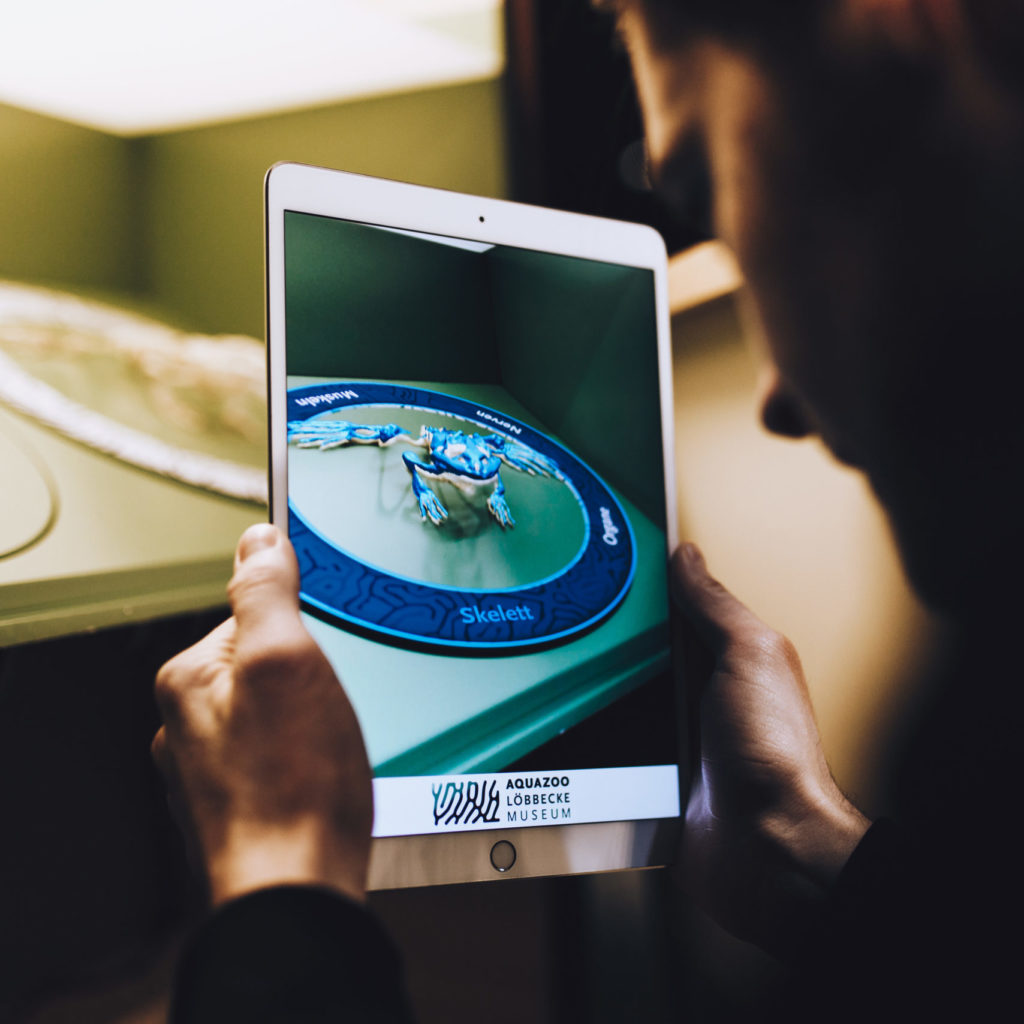
AR easily becomes a gimmick when the technology matters more than the learning. In a museum context, visitors don’t want to figure out a complicated product, they want something that works immediately and helps them understand the exhibit. The interaction had to be simple enough for younger visitors, yet meaningful for adults and educational groups.
It also had to work in a real exhibition: lighting, tracking reliability, spatial constraints, device performance and visitor behaviour all shaped the design. The challenge was both conceptual and technical, make it educational, intuitive and reliable.
My role was to connect the educational objective with a usable digital experience, working closely with teammates across 3D modelling, development and concept design.
We analysed how visitors move through Aquazoo Düsseldorf, where they stop, what draws attention, how information is presented, then looked for the exhibit that would benefit most from an AR layer. The topic needed a real educational reason for AR, not just visual appeal.
Frog anatomy was the strongest direction: it let us reveal internal structures through layered 3D content, giving AR a clear purpose. The physical skeleton on its patterned tracking ring became the anchor for the whole experience.
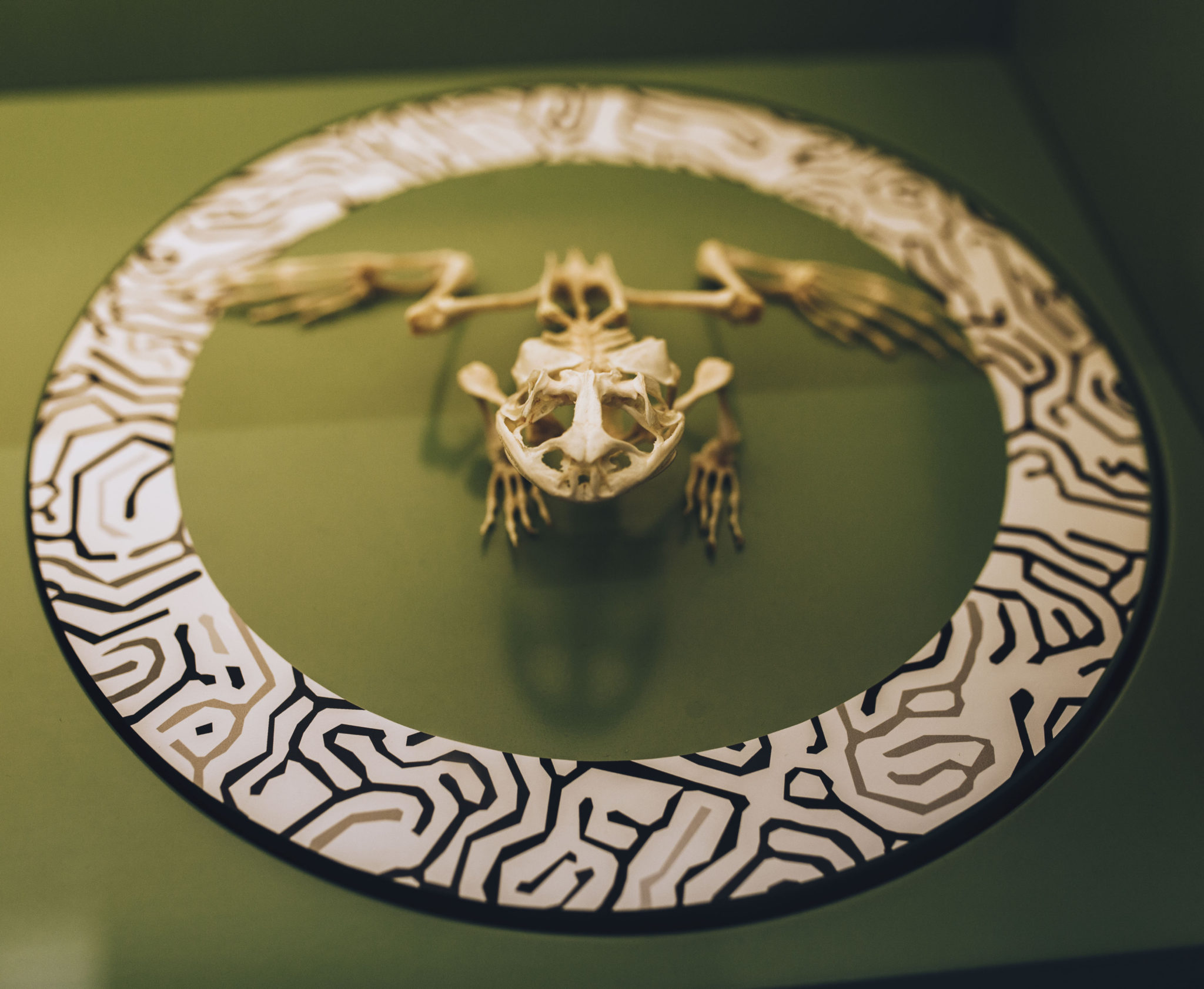
A lightweight UI built around quick access and minimal friction, keeping focus on the exhibit and the AR content.
Anatomical models from photogrammetry, refined in Cinema 4D, detailed enough to teach, optimised to run on mobile.
3D tracking proved unreliable in the space, so we moved to 2D tracking for a more stable foundation.
Visitor testing drove refinement, most notably a scaling feature so small structures became easy to inspect.
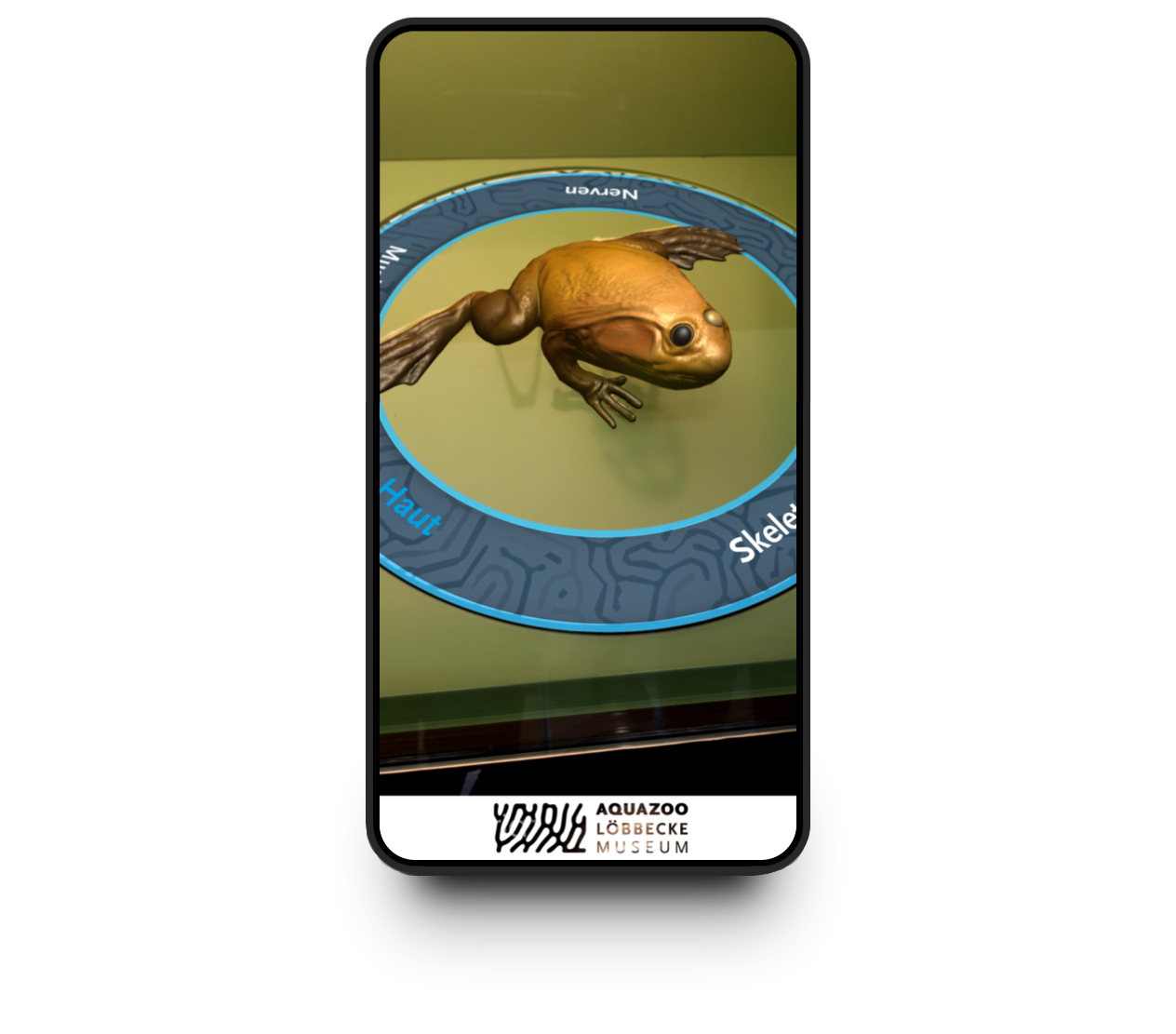
The interface stays out of the way: a single selector ring around the animal lets visitors switch anatomy layers with one tap, while the 3D model stays anchored in real space.
The project resulted in a working mobile AR prototype for Aquazoo Düsseldorf. It extended the physical exhibition with an interactive educational layer and helped visitors explore frog anatomy in a more visual, engaging way, showing how AR can support science communication when it is used with a clear purpose and designed around real visitor behaviour.

AR only works when it disappears, and the biology takes over.
AR is only valuable when it improves understanding. If it doesn’t make the experience clearer, it becomes noise. The technology should not demand attention, it should support the content.
I also learned how strongly physical context shapes digital design. In a real exhibition space, tracking quality, lighting, visitor movement, device handling and attention span all affect the experience. Aquazoo Augmented helped me design more confidently at the intersection of UX, education, 3D content and immersive technology.
Let’s turn your product challenge into something testable.