TraceFoxFounder · AI product design · Product engineering
Every product decision can show its evidence.
I founded, designed and built TraceFox: a Mac app where AI agents find word-for-word evidence in research, people decide what counts, and a decision reopens when its evidence moves.
- Organization
- TraceFox — my own product, Munichtracefox.app (opens in a new tab)
- Period
- 2025 – today
- Role
- Founder · Product design & engineering
- Worked with
- Product leaders interviewed in discovery, PwC among them · product teams at CERN Business Computing, who tested the first MVP
- Methods
- Problem interviews · MVP testing · Three product iterations · Designing in code · AI agent design · AI quality evaluation
- Built with
- Electron and Claude (Anthropic API) for the Mac app; Next.js, Supabase and the AI SDK for the web versions before it
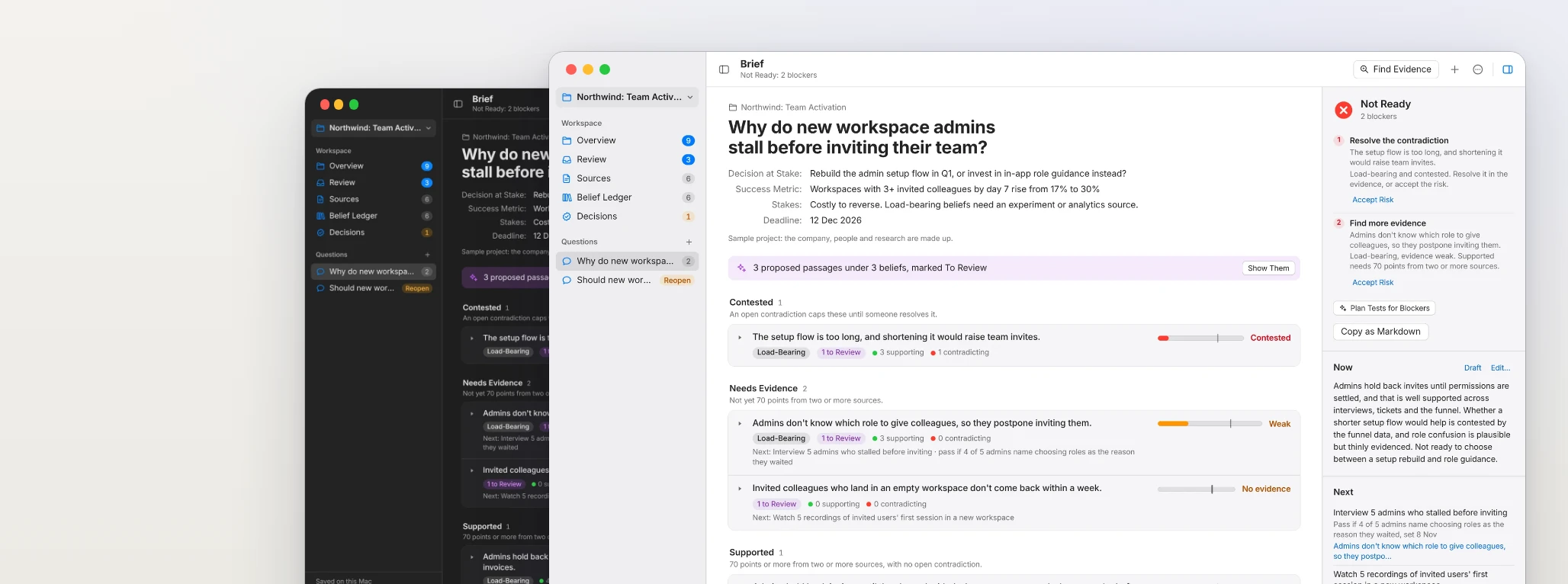
Every screen on this page is a real capture of TraceFox for Mac 1.0, filled with the app’s sample project — the company, people and research are made up. Only the window frames on the banner are re-created; the diagram is drawn for this page.
At a glance
- The problem
- Product teams spend hours reconstructing why a decision was made. The reasoning sits across interviews, tickets and analytics, and AI summaries of that research are hard to check — so decisions get made on evidence nobody can point to.
- The approach
- Three versions in a year, each narrower than the last. From a decision trail across a team’s tools to one loop for one person: write down the decision and the beliefs it rests on, let agents propose word-for-word evidence, and score every belief with rules anyone can recompute.
- The outcome
- TraceFox for Mac 1.0, shipped in November 2026: free, signed and notarized, running on the user’s own API key with no account and no cloud. Still evolving.
Who did what
- Mine
- Everything that made the product: the problem framing and positioning, the research, the interaction and visual design, the evidence model, the agents and their prompts, the engineering of all three versions, the website, and the release.
- Shared
- What the product became: the product leaders I interviewed, and the product teams at CERN Business Computing who tested the first MVP, shaped which problem was worth solving first.
- Theirs
- The language models the agents run on — Anthropic’s Claude, called with each user’s own API key.
01Context
Product decisions lose their reasons.
Product teams spend hours every week reconstructing the reasons behind their decisions. A decision is made on the strength of an interview, a ticket and a chart; months later someone asks why, and the argument has to be rebuilt from scattered tools. The result is rework, features that drift from their intent, and knowledge that leaves with the people who held it.
TraceFox began as a broader idea: a provenance standard for knowledge work, where every claim is backed by evidence and every source is pinned to the version that was read. To find where that mattered most, I interviewed product leaders, PwC among them, about how their decisions were made and remembered — and narrowed the idea to product decisions.
- Product leaders interviewed in discovery
- 5+
- Versions built, each narrower than the last
- 3
- Shipped for Mac, November 2026
- 1.0
02Three versions
From every tool a team uses to one loop for one person.
The first version answered the problem as the interviews framed it: an AI-powered decision memory that joined Jira, Confluence, Figma and Slack into one trail per decision, drawn as a graph with an assistant beside it. Product teams at CERN Business Computing tested the MVP.
- Decision trail2025 · A graph joining Jira, Confluence, Figma and Slack into one trail per decision, with an AI assistant. MVP tested with product teams at CERN.
- Discovery workspaceSpring 2026 · A web app for product managers: research evidence in, a brief of opportunities and assumptions out, every claim traced to a source.
- TraceFox for MacNov 2026 · One person, one loop: a question, the beliefs it rests on, word-for-word evidence, a decision that reopens when the evidence moves.Shipped
Every version moved the same way: away from connecting everything, towards the moment a decision is actually made. The second version, a web app for product managers, turned pasted research into a brief of opportunities and assumptions, each traced to its source. The third kept only the loop at the centre of both — a question, the beliefs it rests on, the evidence for and against each one, and the decision — and made it work for one person on their own Mac.
- Decision
- Prove the core loop for one person before building integrations and team features.
- Why
- A decision trail across a team’s tools is only worth connecting if the loop at its centre — from evidence to a defensible decision — works. That loop can be tested by one person with pasted research; connectors and collaboration can’t make up for it if it doesn’t.
- Trade-off
- TraceFox 1.0 has no connectors and no shared workspace. Sharing means copying a brief out as Markdown, a ticket or a leadership update — the original promise of one trail across a team’s tools is deferred, not delivered.
03The model
A question, the beliefs it rests on, and the evidence for each.
Ask the question
The decision at stake, the metric that proves it worked, and how costly it would be to reverse.
Name the beliefs
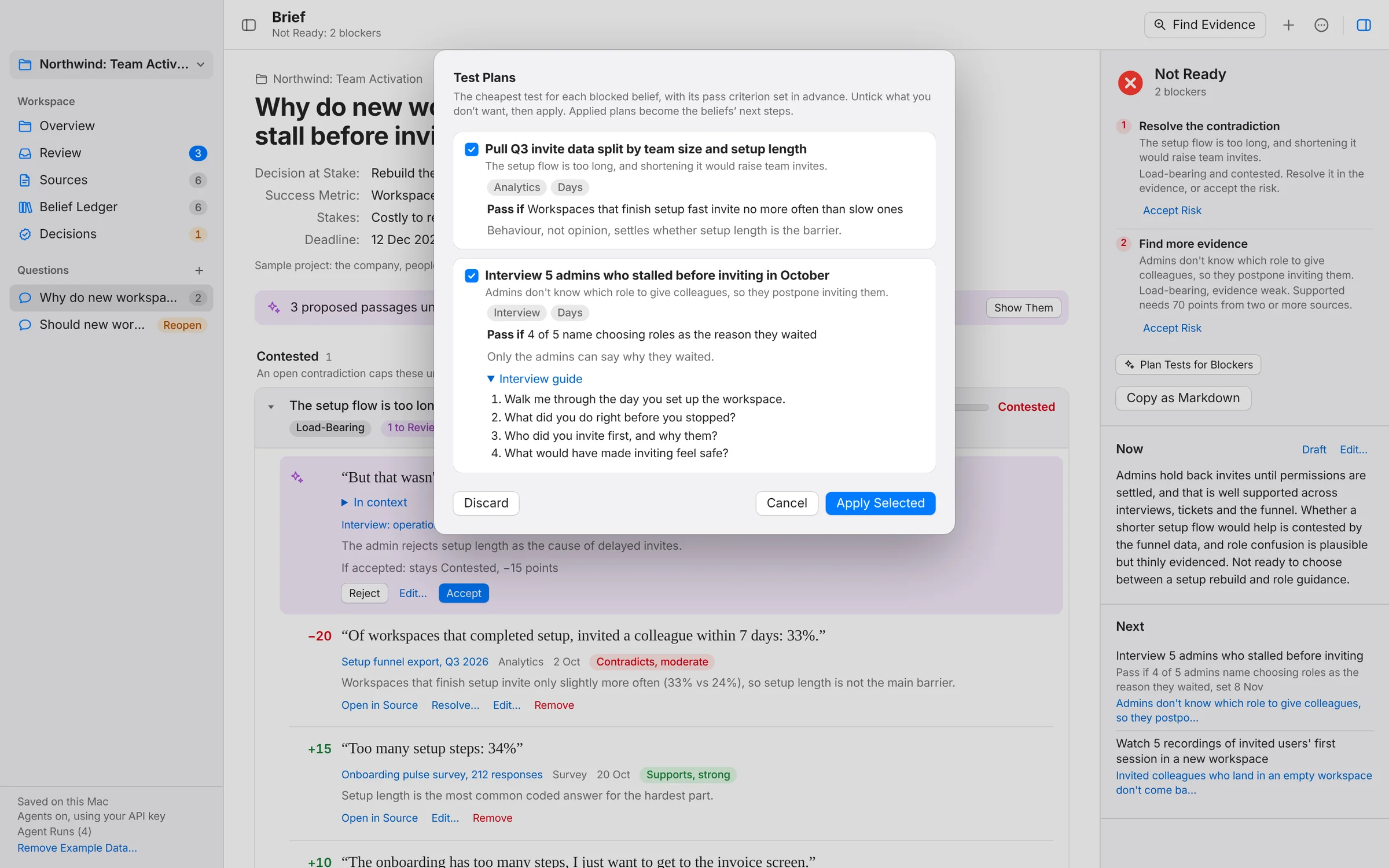
An agent proposes what has to be true for the decision to work, each with a test and a pass criterion set before the results come in.
Bring the evidence
Interviews, ticket exports, surveys, analytics. An agent proposes passages for and against each belief; a person accepts or rejects every one.
Decide, then keep watching
Sign off with the rationale and the beliefs that would reopen the decision. If one of them changes level, TraceFox asks you to look again.
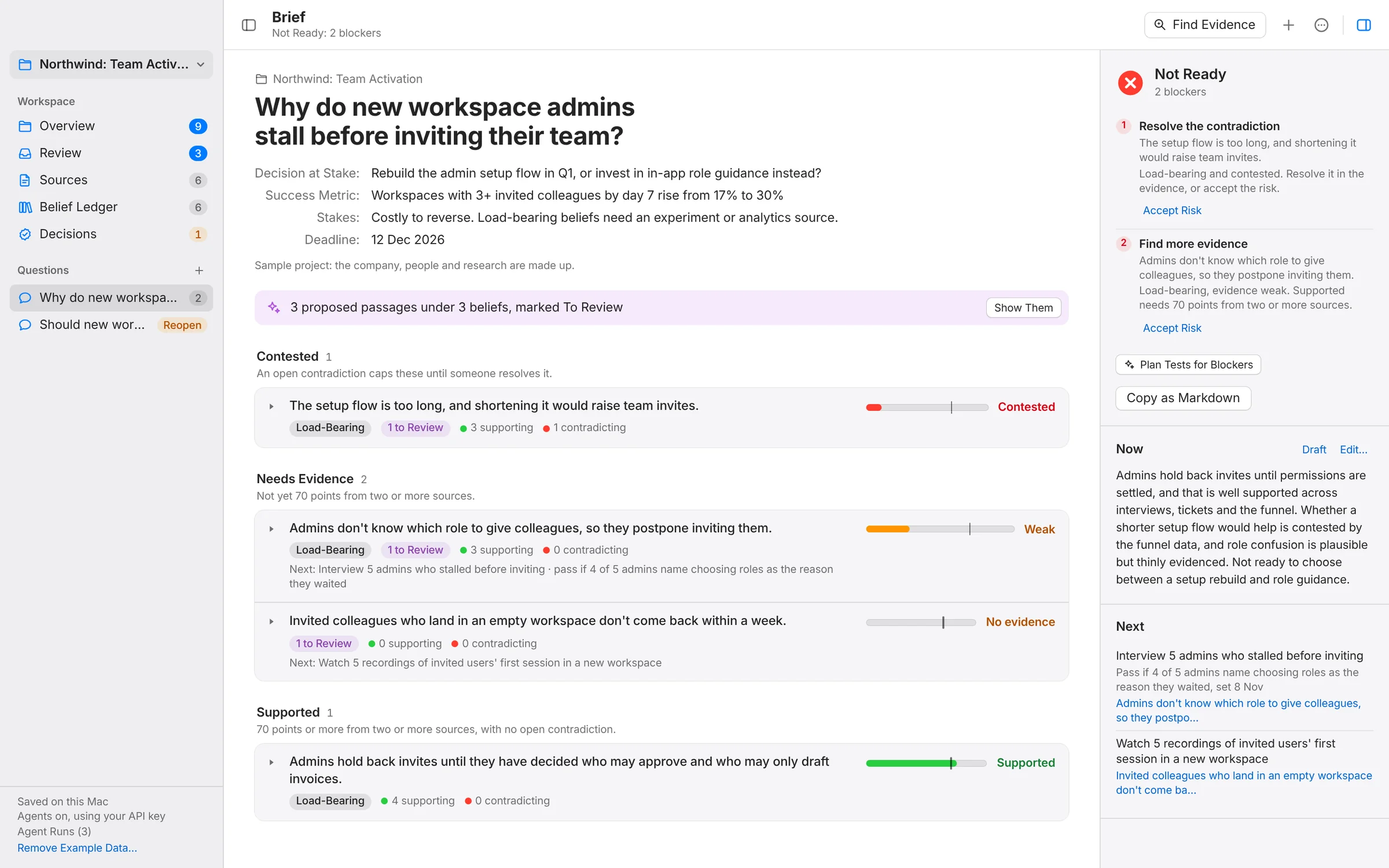
The unit of work is the belief, not the document. Research arrives as transcripts and exports; a decision rests on a handful of statements that have to be true. Putting the beliefs in the middle is what lets the app say something useful: which ones are contested, which are thin, and which one thing to do next about each.
04Checkable AI
Agents propose. People decide. Every quote can be found in its source.
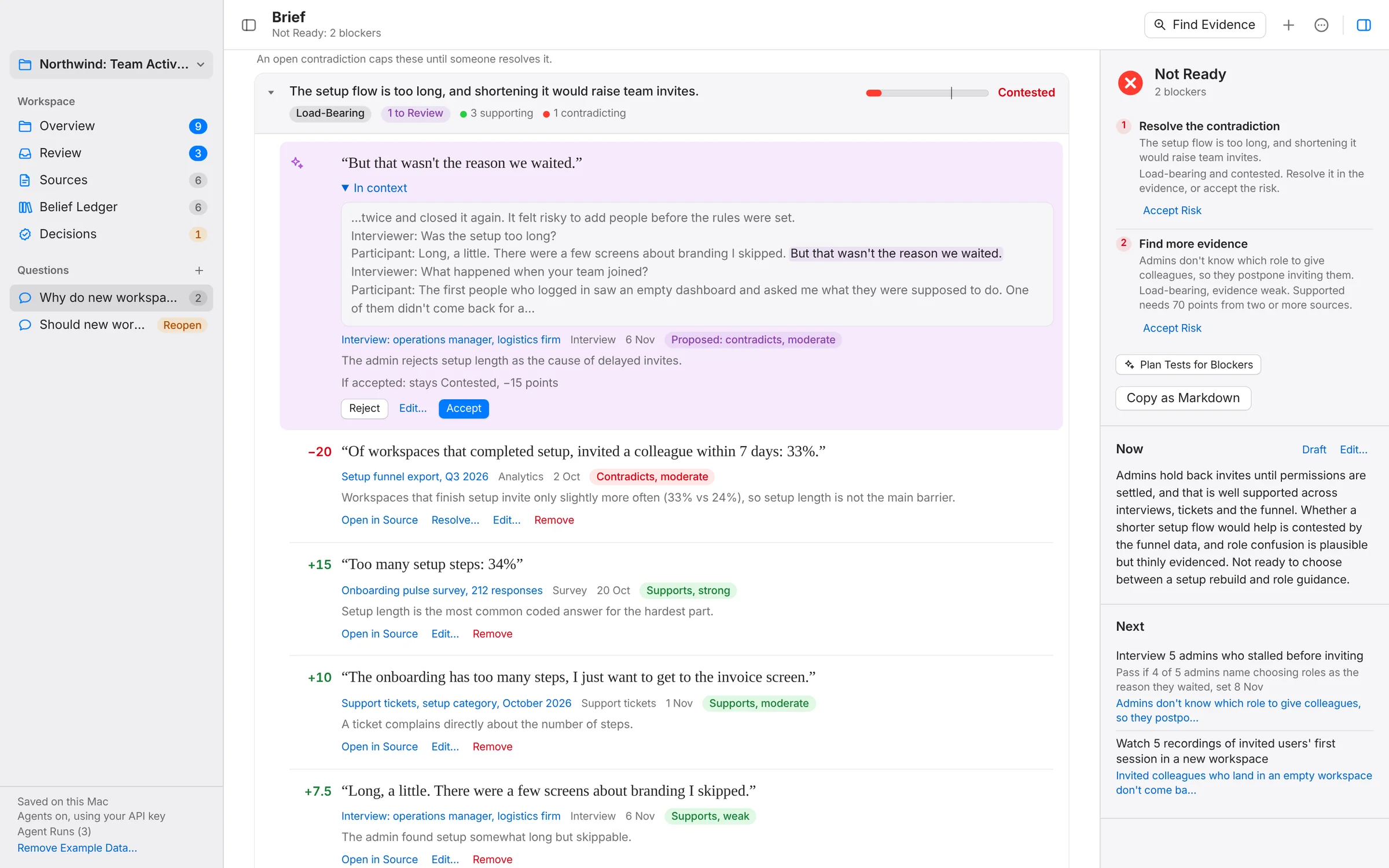
The agents in TraceFox draft beliefs, find passages in the sources, summarise and suggest tests — and decide nothing. Every proposal waits for a person, and each one shows the passage in its context and what accepting it would change before anyone does.
- Decision
- Accept only word-for-word quotes. Drop paraphrases before anyone sees them.
- Why
- A paraphrase asks the reader to trust the model; a quote can be checked against its source. TraceFox verifies that every proposed passage appears in its source exactly, and flags a quote if the source later changes under it.
- Trade-off
- Some useful evidence is lost — a point made across several sentences, or a pattern only a summary would show. The product accepts fewer passages in exchange for every accepted one being checkable.
It is the principle I designed into the review workflow at PwC — every extracted value linked to its evidence — applied to research instead of invoices.
05Honest confidence
Evidence levels anyone can recompute.
In the web version, a model scored confidence and code capped the score by the kind of evidence behind it. For the Mac app I replaced the model’s judgement with rules: each passage earns points by the kind of source and the strength of the passage, a belief is Supported at 70 points from at least two sources with no open contradiction, and an open contradiction caps it until someone resolves it. Hover any number in the app and it shows its arithmetic.
Pick a belief and accept the passages an agent proposed. The level moves by TraceFox’s own rules — try the first with only one interview, then add the others; then accept the funnel data on the second.
Admins hold back invites until they have decided who may approve and who may only draft invoices.
0 points from 0 supporting sources. Supported needs 70 from at least two, and no open contradiction.
- +22.5
I didn’t want anyone else in there until I had decided who could approve invoices and who could only draft them.
Interview 15 × strong 1.5
- +22.5
Our controller insisted that nobody gets access before we agree who signs off on credit notes.
Interview 15 × strong 1.5
- +20
Median time between first visit to Roles and permissions and first invite: 9 days.
Analytics 20 × moderate 1
- +10
We are not inviting anyone yet until our permission setup is final.
Support tickets 10 × moderate 1
- An experiment counts for more than analytics, analytics for more than an interview, an interview for more than a stakeholder’s opinion.
- A second passage from the same source counts half, a third a quarter — one loud interview can’t carry a belief.
- Evidence older than 180 days counts half.
- A decision marked costly to reverse needs an experiment or analytics behind its key beliefs, not only what people say.
- Decision
- Score beliefs with fixed, visible rules instead of a model’s confidence.
- Why
- A number nobody can recompute is an opinion. Points that show their sum can be argued with, corrected and trusted — and they behave the same tomorrow as today.
- Trade-off
- Fixed weights are a judgement call: no rule knows that one particular interview was unusually good. The rules show their working so a person can disagree, and accepting or rejecting a passage stays with them.
06Decisions that reopen
A decision record that notices when its evidence moves.
Signing off records who decided, what they chose, why, on which evidence — and which beliefs would reopen it. When new evidence moves one of those beliefs to a different level, the decision is marked for review. Opening a project starts with what moved since the last visit, decisions to reopen at the top.
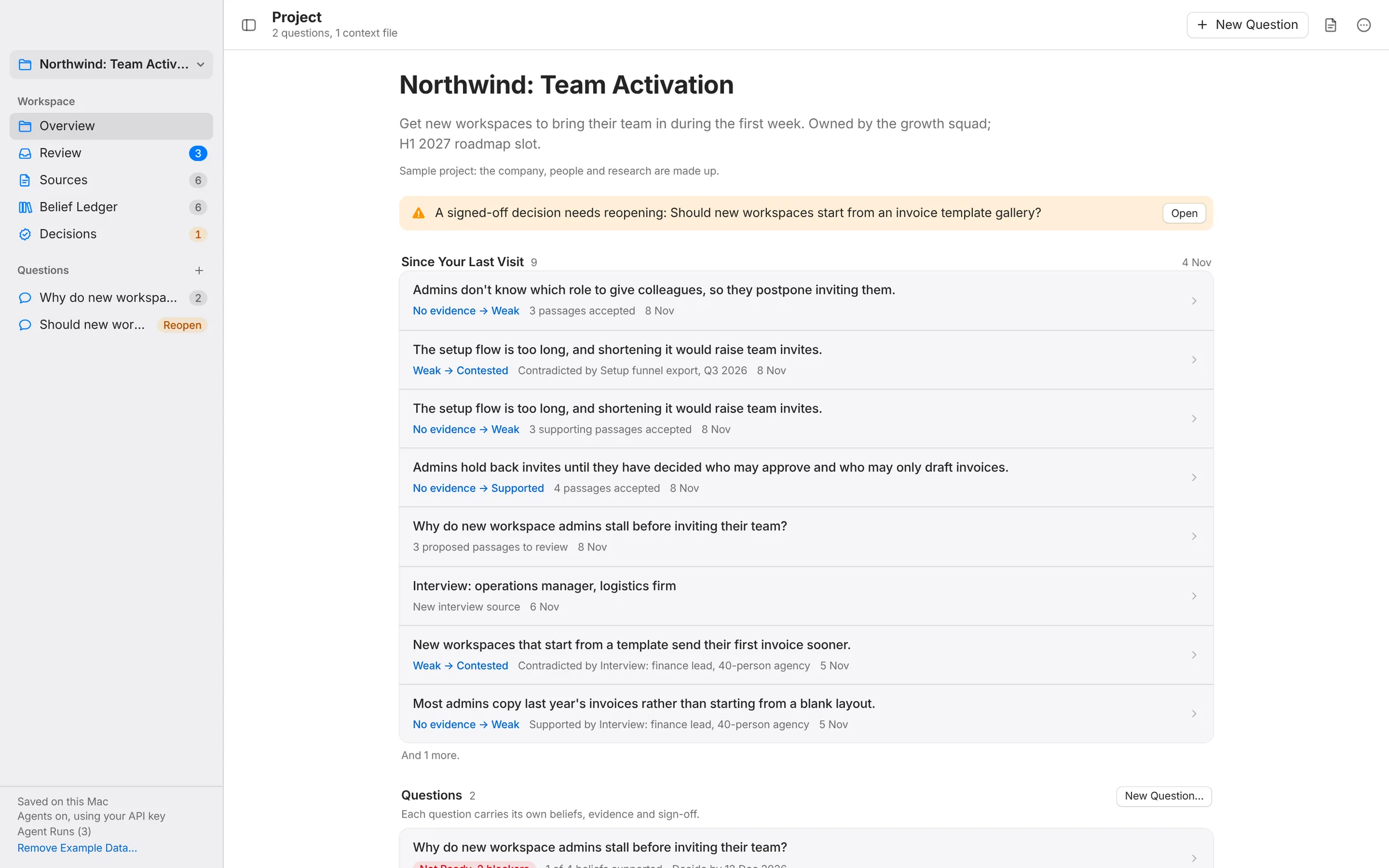
This is where the first version’s promise — never losing the why — survived the narrowing. The why is no longer reconstructed from a team’s tools; it is written down at the moment of the decision, next to the evidence it rested on.
07Shipping it
Free, local, and on the user’s own API key.
Research data is sensitive, and a new product has no reputation to borrow. So TraceFox for Mac asks for none: the workspace is one file on the user’s Mac, the API key is encrypted with the macOS Keychain, and the app talks only to Anthropic, only when an agent runs. No account, no analytics, no tracking. Without a key, it still works by hand.
Try it at tracefox.app (opens in a new tab)Free download for Mac · macOS 12 or later
- Accounts, analytics or trackers
- 0
- Points from two or more sources for Supported
- 70
- Signed, notarized, for Apple silicon and Intel
- 1.0
- Decision
- Ship free, local and bring-your-own-key, rather than as a hosted service.
- Why
- It removes the two reasons not to try it — trusting a startup’s cloud with research data, and paying before knowing whether it helps — and it keeps the product focused on the loop rather than on infrastructure.
- Trade-off
- An API key is real friction for people who have never made one, and a local, single-user app can’t be the team’s shared memory. Both are accepted for 1.0.
08Reflection
What building it myself taught me.
- Narrow until the core loop works for one person. Each version of TraceFox got better by doing less.
- Make AI output checkable rather than asking people to trust it: quotes, not paraphrases; points, not confidence.
- Designing in code, with the real model’s real output, shows problems no static mock-up does — the same lesson as PwC, learnt again as the one who also has to fix them.
- As founder, the hardest design decisions are about what not to build. Each one has a trade-off worth writing down — which is, after all, what TraceFox is for.
Trust in AI is earned one claim at a time — by showing where each claim came from.